From numbers to better decisions, part 3/3: How SMEs can get started with data-driven leadership
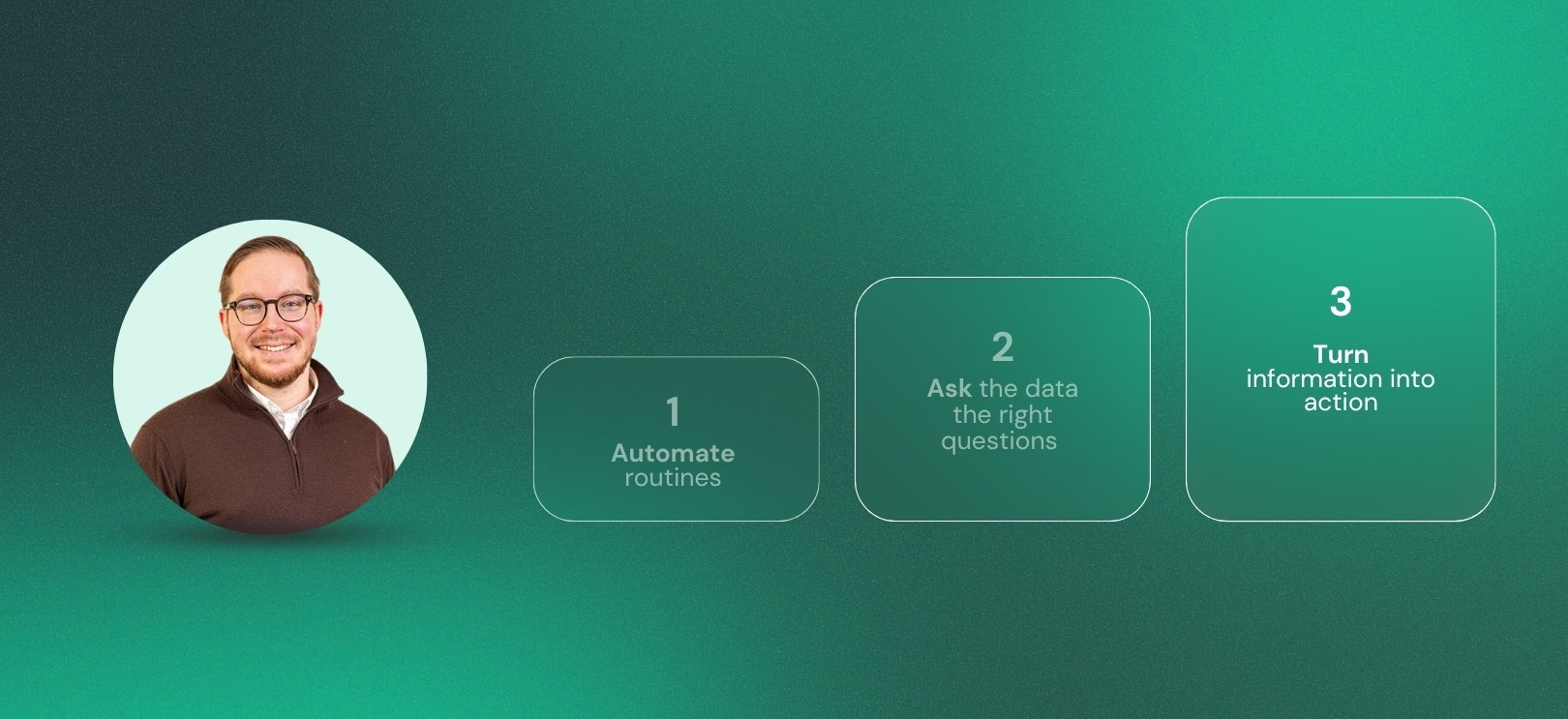
This article is the final part of our expert Pyry Lamminen’s three-part blog series, From Numbers to Better Decisions. In the previous part, we discussed Decision Intelligence and why asking the right questions is what moves things forward. In this concluding instalment, we lay out concrete steps for the journey ahead.
The path toward proactive decision-making analytics is a process, one that takes time, patience, and a commitment to continuous learning.
It often begins when a company recognises the need to change how it operates. Perhaps the old reporting practices no longer cut it, or the business environment has shifted to the point where decision-makers need deeper understanding and better-reasoned solutions.
Three concrete steps toward data-driven leadership
- Start by identifying the areas of the business where data-driven leadership could deliver the most value. Is it improving the customer experience, making better use of resources, or developing new services?
- Next, make sure your data is of sufficient quality and readily accessible. Siloed data across separate systems can be a major bottleneck, but even small steps, like cleaning up how data is collected and stored, can get things moving.
- Third, invest in your team’s capabilities and encourage open discussion about how data is interpreted. As the saying goes, work smarter not harder, but that only works when people feel free to ask questions and challenge what they see.
Rather than only asking “what happened last month?”, try asking: What factors led to this result? What did we do differently when things went well? What can we repeat, and what should we stop?
Data isn’t the answer. It’s the raw material for answers.
Five question types that cover almost everything
The good news is that virtually every analytics need can be framed through five straightforward question types. These aren’t technical terms, they’re ways of formulating questions that data can actually answer:
| Method | Question | Example |
|---|---|---|
| Forecasting | What is likely to happen? | What will sales or cash flow look like over the next 3–6 months? |
| Clustering | Which observations are similar? | What customer segments do we have, and which are the most profitable? |
| Anomaly detection | What doesn’t fit the pattern? | Which cost items or projects are deviating from the norm? |
| Simulation | What would happen if…? | What happens to our bottom line if prices rise 3% or sales drop 10%? |
| Optimisation | What’s the best option? | How should we allocate budget or resources across products or teams? |
Once an SME learns to connect its own questions to these five approaches, it’s already halfway to a solution.
The tools are already there, it’s the thinking that needs to change
There’s a common assumption that leveraging analytics requires heavy system investments or rare technical expertise. In reality, a large share of everyday business questions can be answered with familiar tools like Excel or similar spreadsheet software, existing reporting systems, and simple visualisations.
AI tools like ChatGPT can also help with framing questions, developing modelling logic, and explaining results to others. Analytics is no longer the exclusive domain of “data professionals.” It’s primarily a mindset and a willingness to use the tools you already have more intelligently.
As the saying goes, nothing comes from nothing without the courage to start and the commitment to keep improving, results won’t follow. Every step taken is already a win, and the most important thing is to stay in motion.
In the end, it’s not about how much data you have. It’s about the ability to see through it, and turn it into decisions that move your business forward.
We can help you get moving
You probably already have the data, the tools, and the team. But if decisions tend to be driven more by gut feeling than by evidence, or if reports keep coming in without really leading anywhere — that’s the moment to pause and take stock.
We help you clarify the key questions, build a clear framework together, combine business expertise with data capability, and make better use of your existing tools, without unnecessary complexity.
The goal is for information to support your decisions in everyday life: where to invest, where to cut, what to try next, and how to track success.
Get in touch, and we’ll figure out together where the right starting point is for you.
Takeaways:
- Start where better information actually changes decisions. Don’t try to solve everything at once.
- Data is raw material, not the answer. The right questions matter more than sophisticated systems.
- Analytics doesn’t require big investments — familiar tools are enough when the thinking is right.
- Five question types cover almost everything: forecast, cluster, detect anomalies, simulate, optimise.
- The most important step is the first one, and every step taken moves you forward.