CSRD and Omnibus – what changed and what it means for companies in 2026

The EU's Omnibus I directive is now in force – and it brings changes on who needs to report on sustainability, what they need to report, and when. Around 80% of previously obligated companies fall out of CSRD's scope. Here's everything your company needs to know.
What is Omnibus I?
Omnibus I is an EU legislative package aimed at reducing the corporate sustainability reporting burden and improving European competitiveness. It amends two key directives: the Corporate Sustainability Reporting Directive (CSRD) and the Corporate Sustainability Due Diligence Directive (CSDDD). The Commission published its proposal in February 2025. The European Parliament approved the agreement in December 2025, and the Council gave its final approval on 24 February 2026.
The biggest change: far fewer companies in the CSRD scope
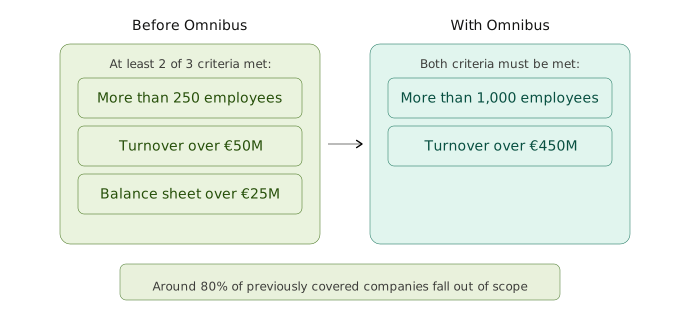
Under the original CSRD, the reporting obligation applied to companies meeting at least two of three criteria: more than 250 employees, turnover above €50 million, or a balance sheet above €25 million. Omnibus raises these thresholds substantially.
New thresholds for CSRD reporting obligations:
- More than 1,000 employees, and
- Annual net turnover exceeding €450 million
Estimates suggest this removes approximately 80% of previously obligated companies from the scope of mandatory reporting.
In practice: if your company employs fewer than 1,000 people or has a turnover below €450 million, you no longer have a mandatory CSRD reporting obligation.
Timeline – who has to report and when?
- Wave 1: no changes. Large listed companies with more than 500 employees that have already reported for the 2024 financial year continue as normal. Omnibus brings no timeline changes for them.
- Wave 2: two-year delay. Large unlisted companies (previously: more than 250 employees) that were due to report for the first time on 2025 data in 2026 receive extra time. ➡ New timeline: reporting begins from financial year 2027, with the first report published in 2028.
- Wave 3: obligation removed entirely. Listed SMEs that were due to begin reporting from the 2026 financial year are fully exempted from the obligation.
What happens to Wave 1 companies that fall below the new thresholds?
Member States may exempt these companies from reporting obligations for financial years 2025 and 2026. A national legislative change is required to implement this, as the original CSRD has already been incorporated into domestic law. The new thresholds fully apply to financial years beginning on or after 1 January 2027.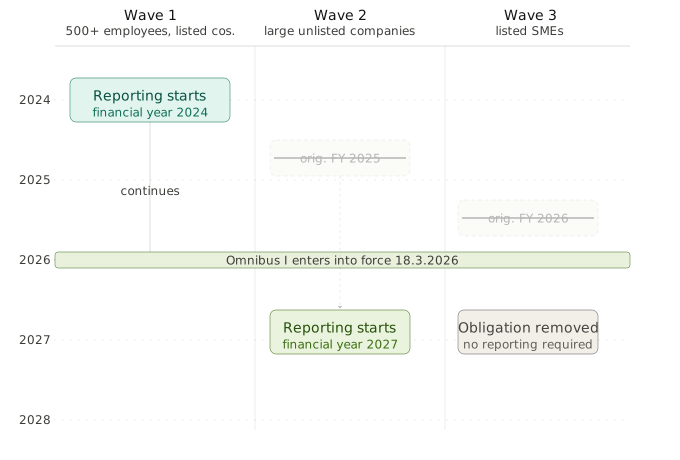
What else changes in CSRD reporting content?
Reporting standards (ESRS) are significantly simplified
The number of mandatory data points is set to be reduced by approximately 61%, and around 70% of data points will be removed from EU Taxonomy reporting templates. This is a substantial relief for companies that have found the standards burdensome and complex.
The European Commission is required to publish revised ESRS standards by September 2026.
Read more: EFRAG has published the simplified ESRS drafts
The role of materiality assessment grows
With Omnibus, the double materiality assessment becomes even more central. In practice, it determines which topics a company needs to report on at all, and at what level of detail – companies are not required to report on matters that are not material to them.
An important change: the materiality assessment no longer needs to be conducted annually. It only needs to be updated when there are significant changes in the company’s operating environment. Companies may determine for themselves when this threshold is reached.
Scenario analysis no longer mandatory
Climate risks must still be identified and assessed, but scenario analysis is removed as a mandatory requirement from the ESRS E1 standard. This is a concrete relief, particularly for companies that have found it onerous.
Value chain protections for smaller companies
Companies with fewer than 1,000 employees may decline requests for sustainability data that exceed the content of the voluntary VSME reporting standard. This reduces the administrative burden on smaller suppliers resulting from data collection requirements from large customers.
Sector-specific standards will not be developed
The previously planned mandatory sector-specific reporting standards have been dropped. Non-binding guidance will be developed instead.
Transition plan obligation removed from CSDDD
The obligation to adopt and implement a climate transition plan is removed from the due diligence directive – however, if a company has one, it must still be disclosed in CSRD reporting.
What to do if you no longer fall within mandatory CSRD reporting scope?
If your company falls outside the reporting threshold, you have three options:
- Voluntary CSRD reporting – for example, if customers, financiers or investors expect it. Voluntary CSRD reporting still requires full compliance with the reporting standards and third-party assurance.
- VSME standard reporting – the EU’s recommended framework for all companies outside the CSRD scope. A lighter and simpler alternative originally designed for SMEs, available in a basic module (numerical reporting) and a more comprehensive module (strategic perspective).
- GRI reporting – if your company has a long history with GRI, it remains a fully valid and widely recognised framework with significant overlap with CSRD requirements.
It is worth noting that markets, financiers and customers will continue to request sustainability data regardless of whether a legal obligation exists. The mandatory requirement may fall away, but expectations do not.
Read more: Your SME is no longer subject to mandatory CSRD reporting – what now?
Practical steps – what to do now
The breathing space created by Omnibus should be used to strengthen structures, not to stand still. Here are recommendations by company size:
Smaller companies (under ~250 employees)
- Map your most material sustainability topics through a lightweight materiality assessment
- Develop a code of conduct
- Begin emissions calculations for key scope 1 and 2 emissions
- Explore whether the VSME standard suits your needs
- Prepare for sustainability data requests from larger customers in your value chain
Growing companies (~250–1,000 employees)
- If you have already started CSRD preparation, build on that work – do not abandon it
- Embed sustainability genuinely into the business: assign ownership to business units, not just a sustainability team
- Develop data collection processes and automate KPI tracking
- Begin ESG data collection from your value chain and engage suppliers
- Set climate targets – financiers and customers will ask for them regardless
CSRD-obligated companies (over 1,000 employees, over €450M turnover)
- Update your double materiality assessment based on the revised ESRS drafts
- Monitor the revised ESRS standards (expected Q2–Q3 2026) and update your reporting plan
- Develop a data model and reporting pipeline: data ownership, quality, traceability
- Make use of the new flexibility: estimates for value chain data are now permitted (provided the methodology is documented)
- Note: the materiality assessment no longer needs to be conducted every year
This article is based on the final text of the Omnibus I Directive (EU) 2026/470 and the updated ESRS drafts published by EFRAG in December 2025. The Directive was published in the Official Journal of the EU on February 26, 2026, and entered into force on March 18, 2026. Council signs off simplification of sustainability reporting and due diligence requirements to boost EU competitiveness – Consilium