Just because we can, should we? Lessons from the HR Hackathon, where HR leaders built AI Apps in a day
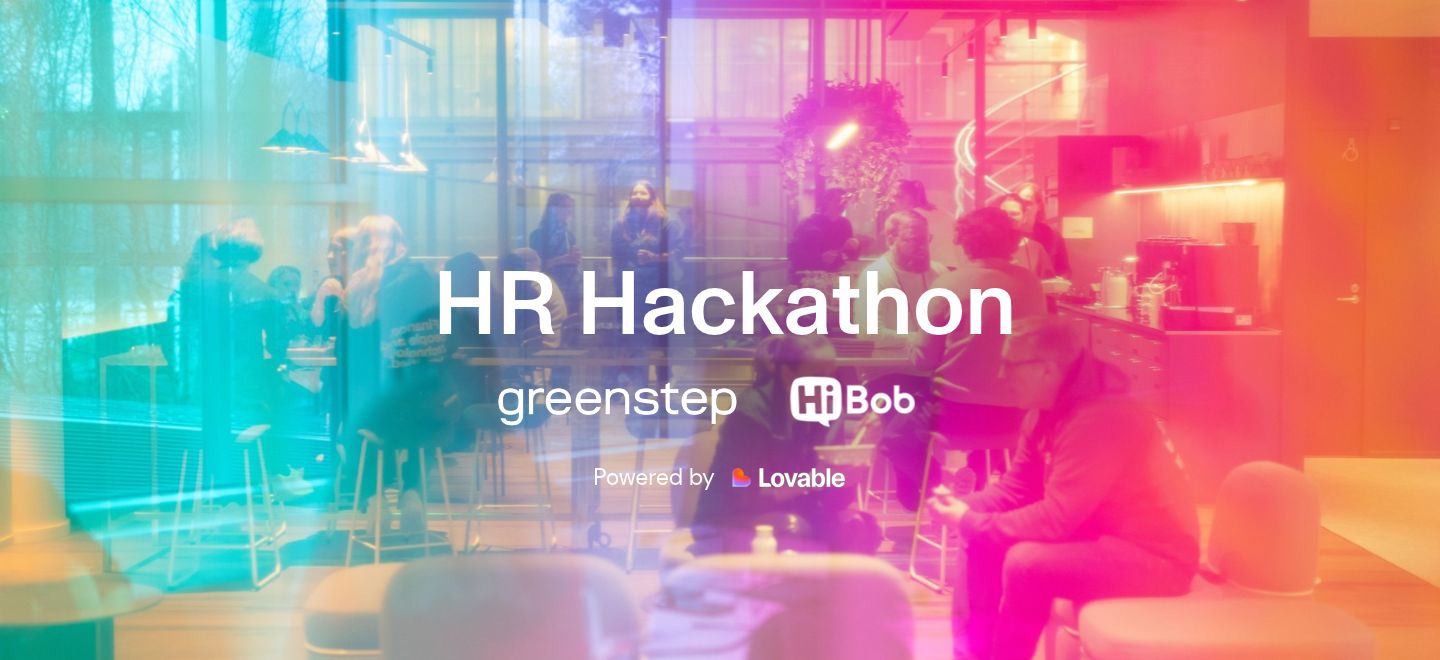
- HR leaders built AI apps in one afternoon without coding, using Lovable, at the HR Hackathon by Greenstep and HiBob.
- AI in HR is moving from assistant to agent, and autonomy is a design choice: read, suggest, act with approval or act within boundaries.
- Routine tasks can go to AI, while decisions that affect people, such as pay and performance, keep a human in the loop.
- Trust comes from transparency: ask AI to show which data it used. The winning app, Oikea Käsi, gathers a manager’s systems into one view.
On 11 November, an auditorium full of HR leaders at Greenstep’s office in Keilaniemi, Espoo, spent the day building their own AI applications. For many, it was the first time.
The HR Hackathon by Greenstep and HiBob gave teams one afternoon and Lovable, a tool that lets you build apps without writing code. The teams picked a real HR challenge and set out to solve it. Underneath every project sat the same question: which parts of HR work can we hand to AI, and which should stay with people?
By the end of the day, the answers were more interesting than “automate everything” or “keep AI away from people matters”.
From an assistant to a colleague
The keynote speaker Maddi Dick, who builds AI-assisted HR work for fast-growing tech companies like Lovable and advises HiBob on innovation, opened with a quick poll. Plenty of hands went up for using AI to answer questions, and plenty for using it as a thinking partner. Only a few had used it as an agent that actually does part of the work.
That last step is where things are heading, she said. Take onboarding as an example: instead of asking AI for an onboarding checklist, an agent can understand the new joiner, their team and their key stakeholders, and then do much of the coordination itself.
Maddi described three shifts in HR work: coordination (the chasing, reminding and following up), execution (carrying out defined steps) and finally work design, which asks why the work happens this way at all. If systems can coordinate and execute, we can no longer assume that today’s workflows should stay as they are.
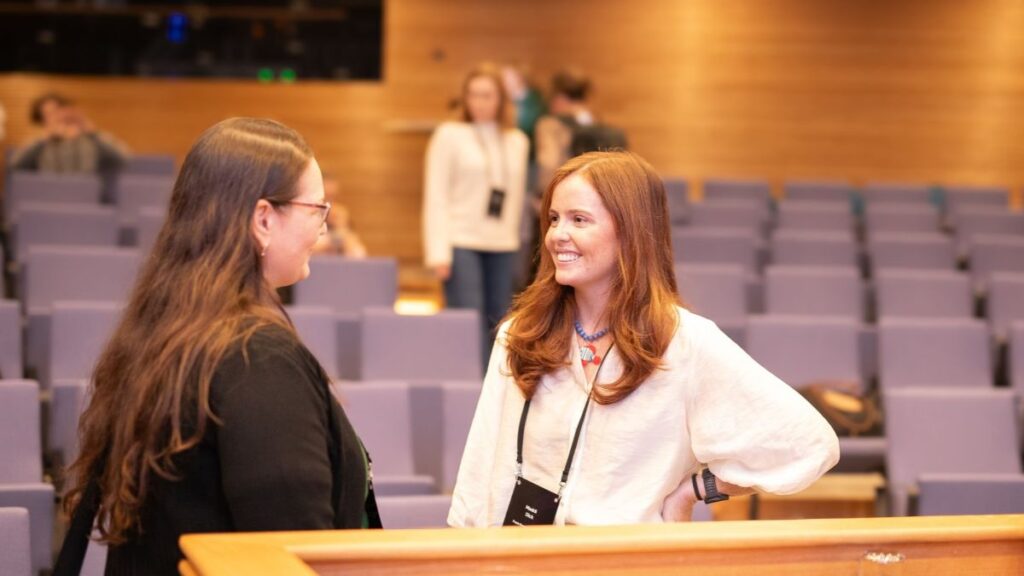
Maddi Dick (right) held a thought provoking keynote speech.
“The interesting question is how work is being redesigned today, not just how it’s made more efficient,” she said. And once systems take over some of the work, the next question follows: what do we want people to spend their time on?
When asked how they felt about all this, the audience was excited, nervous and curious all at once. Maddi’s take was that this is natural, and that HR’s superpower is to stay curious.
Autonomy is a design choice
Then came the question that gave the day its title. Just because we can, should we?
Not every part of HR needs an agent, at least not in its current form, Maddi said. Some tasks are so routine that we would happily hand them to AI today. Others, such as performance and compensation, directly affect the people we work with, and there a human needs to stay in the workflow.
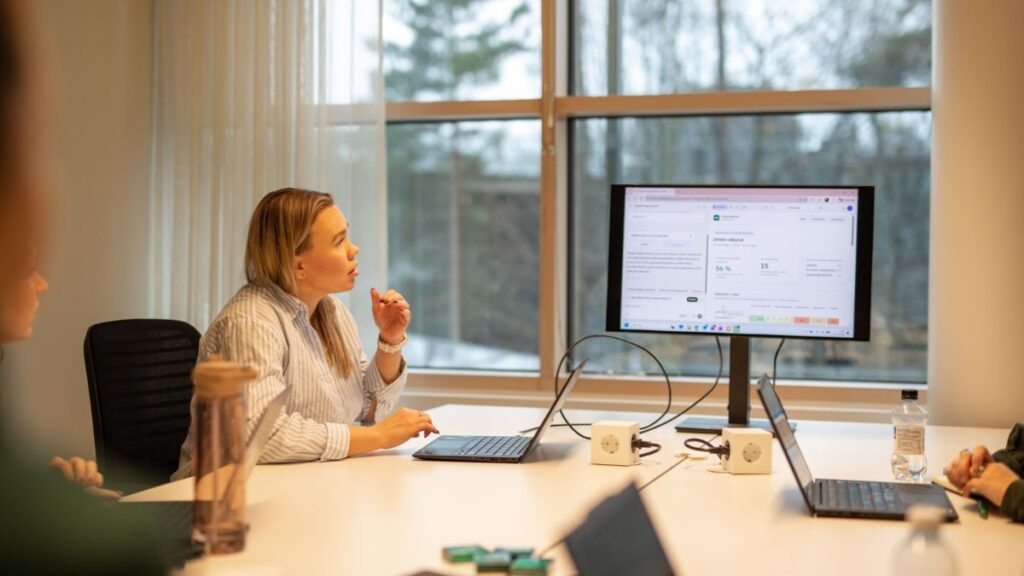
A hundred HR Leaders came together to solve real world HR challenges with the help of AI.
Her practical framing was that autonomy is something you design. A system can read, it can suggest, it can act with approval or it can act within set boundaries. Each step up is a decision, not a default. “As more work is being automated, our responsibility to make work more human grows,” she said.
Jonathan Teir from Greenstep Technology Solutions offered a simple rule for the same choice. Some decisions are two-way doors: they are easy to reverse, so decide fast and let AI proceed. Others are one-way doors, and those a person decides.
“The tools are here. The only limit is how we work,” – Jonathan Teir.
Kati Tuovinen, partner, HR Services from Greenstep summed up the mood in the room: HR can be friends with technology, and that friendship frees HR to focus on people.
Show me where the data comes from
We followed one team through the afternoon. Mia Könnilä is an HR Manager at Raute. Henry Hiltunen works in talent acquisition and training at Tuxera and, as a software engineer by background, is not a traditional HR profile. Lasse Lehto leads HR at Sustera and had already built a pay market agent of his own. The mood at their table was thoughtful and grounded in experience.
The team built a tool around pay market data related to the EU Pay Transparency Directive, and the afternoon followed a familiar rhythm of building, testing and rethinking. When the tool produced a chart that was hard to read, they easily added tabs so the user can choose what to see. When the tool pulled data from public sources, they asked whether it was finding the right and relevant information, and concluded that this part would need more planning.
“Don’t just build something that looks impressive. Build something that matters.” – Maddi Dick
Then compliance came up, as it does in any real HR project: how do you make sure that not just anyone can look up anyone’s salary? That is exactly the kind of question Maddi meant when she talked about compensation being a place where humans stay in the loop.
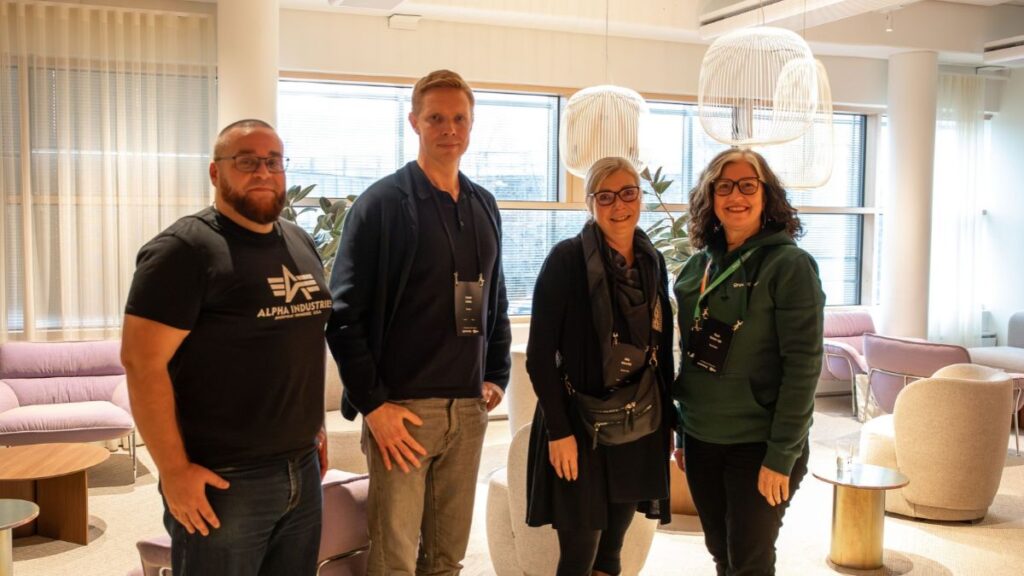
Henry Hiltunen, Lasse Lehto, Mia Könnilä and their host for the day, Greenstep’s Outi Kaivo-Oja.
For Mia, trust depends on where the data comes from. “When AI analyses data taken from our real systems, I can rely on it. When it produces material on its own, I need to check more often.”
Henry has a habit that makes this checking easy. “Once AI has done its calculations, I ask it to show me which fields and which data it used. If something looks off, I see straight away where the information came from.” The worst mistake, he says, is to accept the data as given without questioning it.
Henry sees AI as a tool you can build to show where a human is needed. That idea was perhaps the clearest answer anyone gave to the question of the day.
The winner: a right hand for managers
The jury’s top pick came from a team at the City of Espoo. Their app, Oikea Käsi (“Right Hand”), is built for people leaders such as a manager in early childhood education, whose morning often starts with ten open tabs.
Oikea Käsi connects to the organisation’s core systems and email and gathers everything into one view, with task cards color-coded by urgency. It helps with onboarding, daily tasks and team holiday balances. The team drew a clear line, too: a human is always in the loop, and the app does not send emails on its own or make medical diagnoses for example.
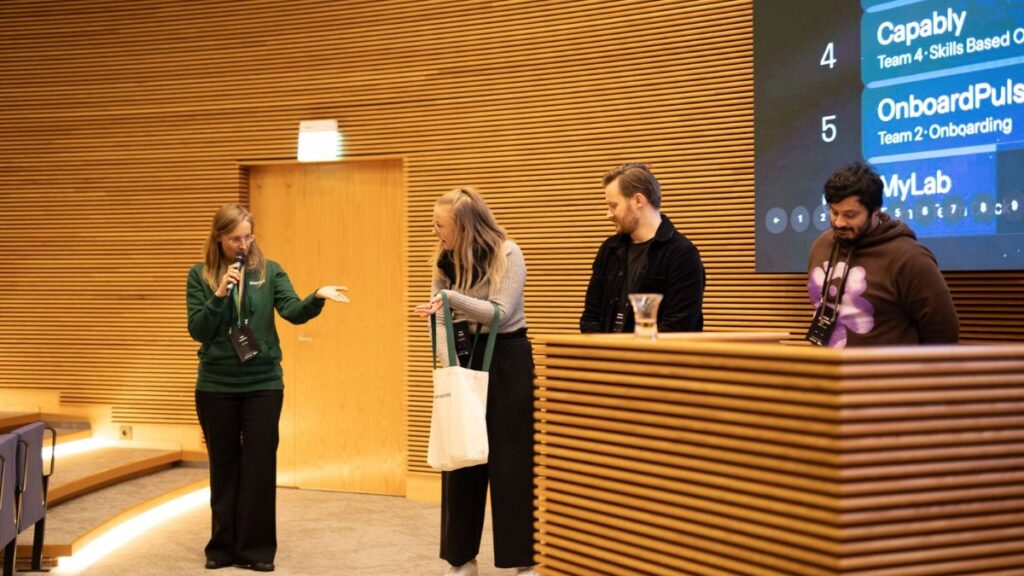
The winning team. Markus Ketonen (middle) bagged his second win in his second hackathon.
The team began the morning with several different visions, and at first everyone built their own part, which produced two different-looking products. They summarized both and let Lovable merge them into one working app. “It’s easy to see what matters and what to do next, and because it’s connected to everything, a manager doesn’t have to move between systems,” says team member Markus Ketonen. It was his second hackathon and his second win.
Start with a skateboard
The apps built in Keilaniemi are prototypes, and that was the point. Maddi’s advice for anyone who wants to build was to start with a skateboard, not a car, and to answer a few questions first. What problem are you solving? Who is it for? What information do you need, and where does it come from? Where do humans need to be involved?
The teams answered those questions in one afternoon, with their own hands. What they took home was less a finished app than a clearer sense of where the line between AI and people should run in their own organisations.
Or, as Maddi put it: “Don’t just build something that looks impressive. Build something that matters.”